
How to Join the Indian Army After Class 10: Career Options and Eligibility
Joining the Indian Army is a dream for many students who want to serve the nation, develop discipline, and build a respected career. For students who have completed Class 10, this is an ideal time to explore defence career opportunities and understand the educational qualifications required for different entry routes.
However, joining the Indian Army involves more than physical fitness. Candidates must understand the eligibility criteria, educational requirements, selection process, and preparation strategies associated with their chosen career path.
In this guide, we will explain how to join the Indian Army after Class 10, the opportunities students can explore, and how to prepare for a future in the defence forces.

Can You Join the Indian Army After Class 10?
Yes, certain Indian Army recruitment categories may be available to candidates who have completed Class 10. However, eligibility depends on the specific post and the requirements mentioned in the official recruitment notification.
Students should understand the difference between joining in an eligible soldier-level category and pursuing a commissioned officer career.
For students who want to become Army officers, continuing education after Class 10 is generally an important part of the journey. The National Defence Academy (NDA) examination is one of the major pathways to becoming a commissioned officer in the Indian Army.
Therefore, before choosing a preparation strategy, students should identify their career goal and check the qualifications required for their preferred entry route.
1. Explore Agniveer Recruitment After Class 10
Agniveer recruitment under the Agnipath scheme is one of the options students can investigate when planning a career in the Indian Army.
Certain Agniveer categories have accepted Class 10 qualifications, while others require different educational qualifications. Candidates must check the requirements for the particular category they intend to apply for.
The recruitment process may include the following requirements and stages, as specified in the relevant notification:
Educational qualification and minimum marks.
Prescribed age limits.
Physical fitness and physical measurement standards.
Medical examination.
Online Common Entrance Examination and subsequent recruitment stages, as applicable.
Meeting the educational criteria alone does not guarantee selection. Candidates must satisfy all the applicable requirements and successfully complete the prescribed selection process.
Students should also understand that Agniveer service is governed by the terms of the Agnipath scheme and is different from a regular commissioned officer career.

2. Complete Class 12 to Pursue the NDA Route
If your ambition is to become an officer in the Indian Army, planning for the NDA examination is an important step.
The Union Public Service Commission (UPSC) conducts the NDA examination for admission to the National Defence Academy. Candidates aspiring to join the Army Wing must meet the prescribed educational and other eligibility conditions.
After completing Class 10, students can start building the foundation they will need for the examination.
Focus on:
Mathematics and regular problem-solving practice.
English grammar, vocabulary, and comprehension.
General knowledge and current affairs.
Logical thinking and reasoning.
Communication skills and personality development.
The NDA selection process also includes the Services Selection Board (SSB) assessment and medical fitness requirements for eligible candidates.
Starting early can help students develop consistent study habits instead of trying to cover the syllabus at the last moment.
3. Which Stream Should You Choose After Class 10?
Choosing the right stream after Class 10 is an important decision for students planning a defence career.
Science stream: Students interested in technical education or keeping the NDA Air Force and Naval Wing options open should consider the relevant subject requirements. These wings require Physics, Chemistry, and Mathematics at the prescribed educational level.
Arts stream: Students can pursue the Army Wing of the NDA with an eligible Class 12 qualification, subject to the applicable conditions.
Commerce stream: Commerce students can also pursue the Army Wing of the NDA, provided they meet the prescribed eligibility requirements.
Your stream should reflect your academic strengths, interests, and long-term plans. Do not assume that Science is compulsory for every defence career.
Before making your final decision, review the latest NDA notification and discuss your options with your teachers or career counsellor.
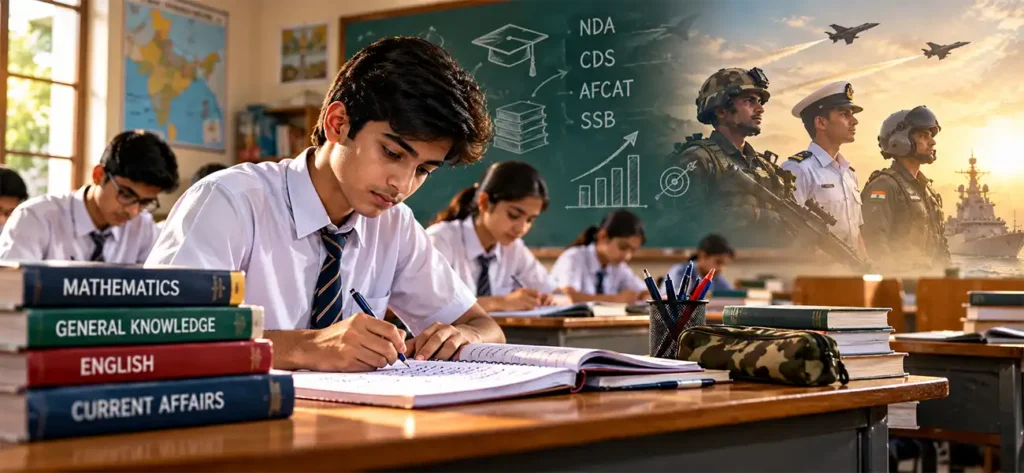
4. How to Prepare for an Indian Army Career After Class 10
Early preparation can help students develop the knowledge, discipline, and fitness needed for future defence selection.
Strengthen Your Academic Foundation
Focus on your school subjects and develop a clear understanding of fundamental concepts. Regular revision, practice tests, and reading habits can improve your performance in competitive examinations.
Students planning for NDA should pay particular attention to mathematics, English, and general knowledge.
Improve Your Physical Fitness
Physical fitness is an important aspect of military life and recruitment. Build a balanced routine that includes running, basic strength exercises, stretching, and outdoor activities.
Increase the intensity gradually and allow adequate time for recovery. Always follow the physical standards and training guidance relevant to your intended entry route.
Develop Discipline and Time Management
Create a realistic daily timetable that balances schoolwork, exercise, rest, and revision. Consistency is more useful than following an unnecessarily difficult routine for a few days.
Learning to manage your time also helps you prepare for competitive examinations alongside regular school studies.
Improve Communication and Awareness
Read reliable news sources, follow important national developments, and practise expressing your ideas clearly.
These habits can help you improve general awareness and communication skills, which are useful for defence examinations and later stages of selection.
Understand the Selection Process
Learn about the examination pattern, age requirements, educational qualifications, physical standards, and medical criteria for your chosen entry route.
Always rely on official recruitment notifications rather than unverified social media posts.
5. How Can Defence-Oriented Education Help Students?
Defence-oriented education can provide a structured environment for students who want to develop discipline, confidence, leadership, and physical fitness.
Depending on the institution and programme, students may receive academic support, physical training, personality development activities, and guidance for defence entrance examinations.
Parents considering such an institution should evaluate its curriculum, teaching approach, facilities, student support, and suitability for their child’s needs.
For students planning their long-term defence journey, Indian Defence School provides an opportunity to explore defence-focused educational guidance and preparation options.
The right educational environment should support a student’s academic development while helping them understand the demands of their chosen career.

6. Common Mistakes to Avoid While Planning a Defence Career
Students can make better decisions by avoiding a few common mistakes.
Relying on outdated eligibility information: Recruitment rules and age limits can change. Always check the latest official notification before applying.
Ignoring academic preparation: Physical fitness is important, but candidates must also satisfy the educational and examination requirements of their chosen entry route.
Choosing the wrong career pathway: Agniveer recruitment and commissioned officer entry have different requirements and career structures. Understand these differences before making a decision.
Neglecting medical and physical standards: Review the prescribed requirements early so you know what is expected.
Waiting until the application period: Building academic knowledge, fitness, and good habits takes time. Start preparing well before the relevant examination or recruitment cycle.