
RIMC vs RMS vs Sainik School: Which Is Better for Your Child?
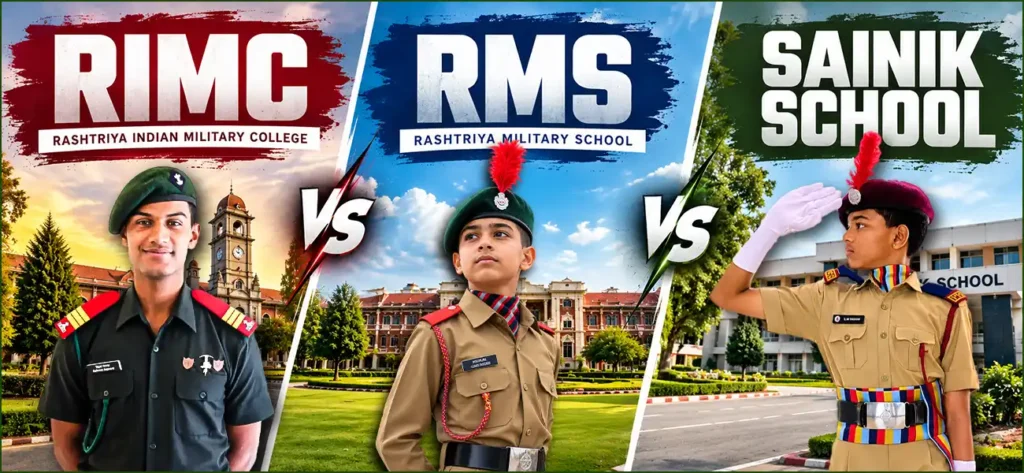
When parents start exploring defence-oriented education, three names often come up: RIMC vs RMS vs Sainik Schools. All three are known for combining academics with discipline, physical development and character building. However, they are not identical.
Each follows its own admission system and offers a somewhat different school experience. Therefore, rather than asking which institution is simply “the best,” parents should ask a more useful question:
Which school matches my child’s age, abilities, interests and long-term goals?
This guide to RIMC vs RMS vs Sainik School explains the differences in a simple way so parents can make an informed decision.
Understanding RIMC
The Rashtriya Indian Military College (RIMC) in Dehradun is a residential educational institution with a long history of preparing young students for disciplined academic and leadership-oriented environments.
One of the major things that makes RIMC different is its admission stage. The principal entry is at Class VIII, so students normally begin thinking about RIMC a little later than children preparing for Class VI admissions.
Life at RIMC goes beyond classroom lessons. Students experience a structured routine involving academics, sports, activities, discipline and opportunities to develop leadership qualities.
For a student who enjoys a competitive academic environment and is comfortable following a well-organised routine, RIMC can be an option worth exploring.
Understanding RMS
Rashtriya Military Schools (RMS) are residential schools under the Ministry of Defence. They provide students with a CBSE-based academic education along with a structured boarding-school environment.
The traditional RMS network includes schools at Ajmer, Bengaluru, Belgaum, Chail and Dholpur.
Students generally enter through Class VI or Class IX, depending on the applicable admission rules. Selection is based on the Common Entrance Test and subsequent stages prescribed for the admission cycle.
The RMS environment places importance on classroom learning as well as sports, discipline, teamwork and personal development.
For parents looking for a residential school where academics and a disciplined lifestyle are combined, RMS can be one of the options to consider.
Understanding Sainik Schools
Sainik Schools have a broader presence across India and are designed around a combination of education, discipline, physical development and leadership.
Admission is generally offered through the All India Sainik Schools Entrance Examination (AISSEE) for the applicable classes, primarily Class VI and Class IX.
One important difference is that the Sainik School system has expanded beyond the traditional Sainik Schools, with New Sainik Schools also being introduced under the government’s initiative.
This gives parents a wider range of institutions to explore, but the exact facilities, location, school environment and admission availability can differ from one school to another.
RIMC vs RMS vs Sainik School: What Really Changes?
At first glance, the three may appear similar because they all promote discipline and defence-oriented values. The differences become clearer when parents look at the entry class, examination, school environment and preparation requirements.
1. Admission Class
The first thing to check is whether your child is eligible for the desired institution.
RIMC: Primarily offers admission to Class VIII.
RMS: Primarily offers admission to Classes VI and IX.
Sainik Schools: Primarily offer admission to Classes VI and IX through AISSEE.
Since age and educational qualifications are linked to the admission year, parents should always verify the latest official notification before planning preparation.
2. Entrance Examination
The entrance tests are not interchangeable.
A child preparing for RIMC needs to follow the RIMC examination pattern, while an RMS aspirant prepares according to the RMS Common Entrance Test. Students targeting Sainik Schools need to prepare for AISSEE.
This means preparation should begin with the target examination rather than using one generic study plan for all three.
3. Academic Preparation
Students preparing for these schools need a strong foundation in their respective entrance-test subjects.
However, preparation should not be limited to memorising answers.
A good preparation routine should include:
Concept-based learning
Regular question practice
Mental ability and reasoning exercises where applicable
Vocabulary and language development
General awareness
Timed mock tests
Revision of weak topics
The objective is to make the student comfortable with both the subject matter and the pressure of an entrance examination.
4. Life Beyond the Classroom
A major attraction of these schools is their emphasis on activities outside academics.
Students may participate in sports, physical activities, competitions, clubs, group activities and other programmes that encourage teamwork and responsibility.
This is particularly useful for children who enjoy an active routine rather than spending their entire school day focused only on textbooks.
5. Discipline and Independence
Residential education requires children to gradually become more independent.
Students learn to manage their belongings, follow schedules, complete responsibilities and adjust to living and learning with other students.
For parents, this is an important consideration. A child should be emotionally and practically prepared for a boarding-school environment before applying.
Which One Should You Choose?
Instead of comparing RIMC, RMS and Sainik Schools only by reputation, consider your child’s individual situation.
Consider RIMC if:
Your child is aiming specifically for the RIMC admission opportunity, is comfortable with a competitive selection process and is ready for a structured residential environment.
Consider RMS if:
You are looking for a residential CBSE school with a disciplined routine and your child is eligible for the applicable RMS entrance process.
Consider Sainik School if:
You want to explore the wider Sainik School network and your child is preparing for AISSEE for the relevant admission class.
There is no universal formula that works for every family. A school that suits one student perfectly may not necessarily suit another.
How Parents Can Start Preparation
The biggest mistake parents can make is waiting until the examination is very close before beginning preparation.
A better approach is to first identify the target school and then create a realistic study schedule.
Start by checking:
Step 1: Confirm age and class eligibility.
Step 2: Download and understand the latest official examination syllabus.
Step 3: Identify subjects where your child needs additional support.
Step 4: Build strong fundamentals before moving to advanced question practice.
Step 5: Introduce mock tests gradually.
Step 6: Track mistakes instead of simply counting marks.
Step 7: Include outdoor activities and physical exercise in the daily routine.
Most importantly, preparation should not make the child feel that everything depends on one examination. The aim should be to develop better study habits, confidence and discipline along the way.
Preparing for RIMC, RMS & Sainik School at Indian Defence School
At Indian Defence School, Dehradun, students can prepare for defence-oriented school entrance examinations through a structured academic and activity-based approach.
Preparation can include classroom learning, practice sessions, assessments, doubt-solving and personality development. Students can also work on the skills needed to approach competitive entrance examinations with greater confidence.
For parents, the focus should not only be on completing a syllabus. It should be on helping the child become a more disciplined, confident and independent learner.
RIMC vs RMS vs Sainik School: The Final Decision
RIMC, RMS and Sainik Schools share several common values, but they offer different admission routes and school experiences.
The right starting point is therefore not:
“Which school is number one?”
Instead, ask:
“Which school fits my child’s age, preparation level, personality and educational goals?”
Once the target is clear, preparation becomes much more focused.
Whether your child is preparing for RIMC, RMS or Sainik School, consistent study, regular practice, physical activity and parental support can make the preparation journey more organised.
Start early, understand the examination requirements and choose a preparation strategy based on the specific school your child wants to target.
Frequently Asked Questions
Is RIMC the same as RMS?
No. RIMC and RMS are separate defence-oriented educational institutions with different admission processes and entry classes.
Can a student prepare for RIMC, RMS and Sainik School at the same time?
Some foundational subjects and skills overlap, but each examination has its own pattern and requirements. Students should study the specific syllabus and exam structure of their target institutions.
Which class can students enter RIMC?
The primary admission entry at RIMC is Class VIII, subject to the eligibility conditions of the relevant admission cycle.
When can students apply for RMS?
RMS generally conducts admission for Classes VI and IX, subject to the eligibility rules and vacancies announced for the particular academic session.
How are students admitted to Sainik Schools?
Admission is generally through the AISSEE, followed by the applicable counselling and selection process.
Is coaching necessary for these entrance examinations?
Coaching is not the only route to success. Students can prepare independently with good study material and a disciplined routine. However, structured coaching can provide a planned syllabus, regular assessments, practice and guidance, which some students and parents may find useful.