
AFCAT Test: Complete Guide to Eligibility, Pattern, Syllabus & Selection Process for Indian Air Force Officers
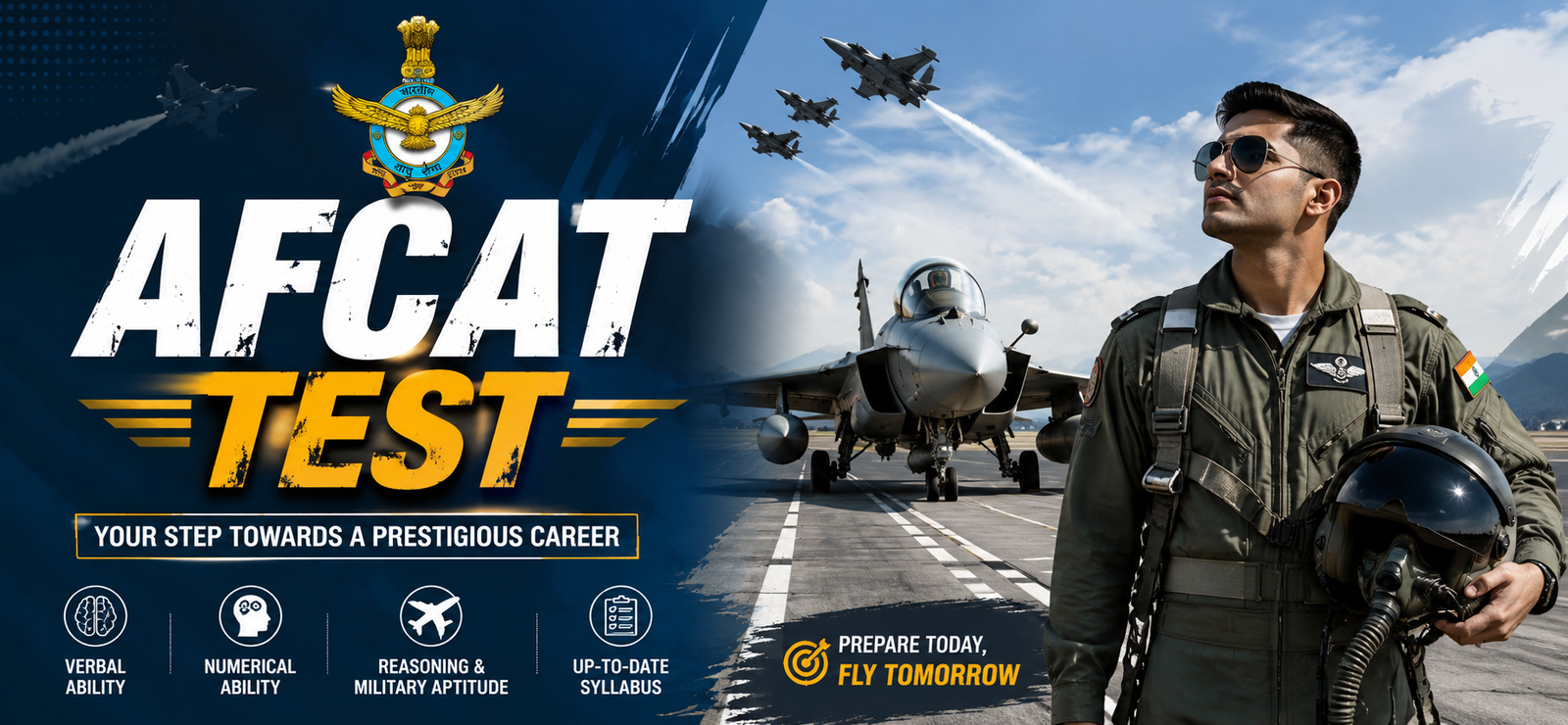
The dream of soaring through the skies or serving in the elite ranks of the Indian Air Force begins with one crucial gateway — the AFCAT Test. Known fully as the Air Force Common Admission Test, this national-level examination opens doors for young men and women to join as commissioned officers in the Flying Branch, Ground Duty (Technical), and Ground Duty (Non-Technical) branches.
Conducted twice every year by the Indian Air Force, the AFCAT Test is designed to identify candidates with the right mix of intellect, aptitude, physical fitness, and officer-like qualities. Whether you aspire to fly fighter jets, manage advanced aircraft systems, or handle critical administrative and logistical roles, clearing the AFCAT Test is the first major step toward a prestigious career in the IAF.
What is the AFCAT Test? Key Facts Every Aspirant Must Know
The AFCAT Test is an online computer-based examination that evaluates a candidate’s general awareness, English language skills, numerical ability, reasoning, and military aptitude. It is open to both male and female candidates and serves as the primary entry route for Short Service Commission (and in some cases Permanent Commission pathways through related entries).
Key highlights of the AFCAT Test include:
- Conducted twice a year (AFCAT 1 and AFCAT 2)
- Online mode with objective-type multiple-choice questions
- Separate Engineering Knowledge Test (EKT) for technical branch aspirants
- Followed by Air Force Selection Board (AFSB) interview, medical examination, and final merit list
The exam is highly competitive yet structured, giving well-prepared candidates a clear path to success.
AFCAT Test Eligibility Criteria: Age, Education & Nationality
To appear for the AFCAT Test, candidates must meet specific eligibility conditions that vary slightly by branch.
Nationality Must be a citizen of India as per the Indian Citizenship Act, 1955.
Age Limit (as applicable for the course commencing year)
- Flying Branch: 20 to 24 years
- Ground Duty (Technical & Non-Technical): 20 to 26 years Upper age relaxation of up to 26 years is available for Flying Branch candidates holding a valid Commercial Pilot Licence issued by DGCA.
Educational Qualification
- Flying Branch: Minimum 50% marks each in Physics and Mathematics at 10+2 level + Graduation (minimum 60% marks) or BE/B.Tech (60%) or equivalent.
- Ground Duty (Technical): Minimum 50% in Physics & Mathematics at 10+2 + four-year engineering degree (60% marks) in relevant disciplines.
- Ground Duty (Non-Technical): Graduation in any discipline with minimum 60% marks.
Candidates must also meet prescribed medical and physical standards, including height, vision, and overall fitness parameters.
AFCAT Test Exam Pattern & Marking Scheme
Understanding the exact pattern of the AFCAT Test is essential for smart preparation.
AFCAT Written Examination
- Mode: Online
- Duration: 2 hours
- Total Questions: 100
- Maximum Marks: 300
- Subjects: – General Awareness – Verbal Ability in English – Numerical Ability – Reasoning and Military Aptitude Test
Marking Scheme
- +3 marks for every correct answer
- –1 mark for every incorrect answer
- No marks deducted for unattempted questions
Engineering Knowledge Test (EKT)
Mandatory only for candidates applying to Ground Duty (Technical) branch.
- 50 questions
- 150 marks
- 45 minutes
- Subjects based on Mechanical, Computer Science, or Electrical & Electronics streams
The AFCAT Test is conducted entirely in English and focuses on testing both knowledge and analytical ability under time pressure.
Detailed Syllabus of the AFCAT Test
A well-rounded preparation strategy for the AFCAT Test covers the following areas:
- General Awareness: History, Geography, Polity, Economy, Science, Current Affairs, Defence-related knowledge, and Environmental Science.
- Verbal Ability in English: Comprehension, Error Detection, Vocabulary (Synonyms/Antonyms), Idioms & Phrases, Sentence Completion, and Cloze Test.
- Numerical Ability: Arithmetic (Percentage, Profit & Loss, Ratio, Time & Work, Speed & Distance), Algebra, Geometry, and Data Interpretation.
- Reasoning & Military Aptitude: Verbal and Non-Verbal Reasoning, Spatial Ability, and questions designed to assess military-oriented thinking.
Consistent practice with previous years’ papers and mock tests significantly improves performance in the AFCAT Test.
AFCAT Test Selection Process: From Written Exam to Commissioning
Clearing the written AFCAT Test is only the beginning. The complete selection process includes:
- Written Examination (AFCAT + EKT if applicable)
- Air Force Selection Board (AFSB) Testing – A multi-day process involving Officer Intelligence Rating (OIR), Picture Perception & Discussion Test (PPDT), Psychological Tests, Group Tasks, Personal Interview, and Computerised Pilot Selection System (CPSS) for Flying Branch aspirants.
- Medical Examination – Conducted at designated Air Force medical establishments.
- Final Merit List – Prepared based on written exam performance and AFSB recommendations, subject to medical fitness and vacancy availability.
Successful candidates undergo rigorous training at the Air Force Academy, Dundigal (or other designated training establishments), lasting approximately 50–62 weeks, depending on the branch.
Why the AFCAT Test is a Life-Changing Opportunity
Clearing the AFCAT Test offers more than a job — it offers a lifestyle of honour, adventure, leadership, and service to the nation. Officers enjoy competitive pay (starting at Level 10 with a basic pay of ₹56,100), attractive allowances, free medical facilities, housing, and excellent career progression. Most importantly, they become part of one of the world’s most respected air forces.
Building the Foundation for Defence Success
While the AFCAT Test is typically attempted after graduation, the journey toward a successful defence career begins much earlier. Strong fundamentals in academics, physical fitness, discipline, leadership qualities, and officer-like qualities are developed best in a structured, value-driven environment during school years.
Indian Defence School, recognised as the Best Army Boarding School in India, specialises in preparing young aspirants through focused coaching for RIMC and Sainik School entrances. With experienced mentors, a genuine military-style boarding environment, rigorous academics, and character-building programmes, Indian Defence School lays the strongest possible foundation for students who later aim for NDA, AFCAT, and other prestigious defence pathways. The habits of discipline, resilience, and leadership nurtured here give aspirants a decisive edge when they eventually face competitive examinations like the AFCAT Test.