
RIMC Admission: Complete Guide to Eligibility, Process, Exam Pattern, and Success Tips
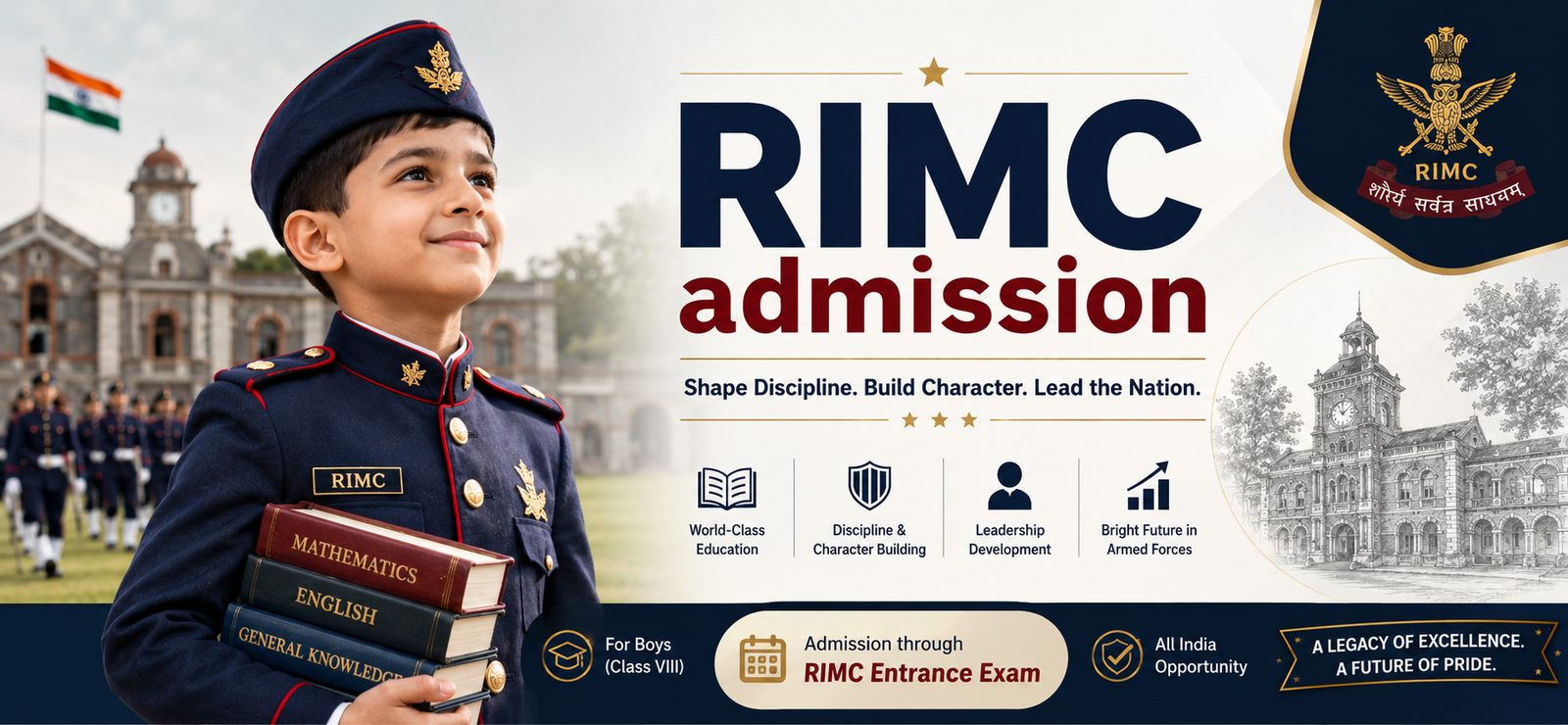
Securing a seat through RIMC admission is one of the most prestigious pathways for young students aspiring to join the Indian Armed Forces. The Rashtriya Indian Military College (RIMC) in Dehradun stands as a premier inter-services institution under the Ministry of Defence, often called the “Cradle of Excellence.” Established in 1922, it prepares boys and girls for leadership roles, with a strong track record of feeding cadets into the National Defence Academy (NDA) and other defence academies.
This detailed guide covers every essential fact about RIMC admission — from eligibility and age criteria to the selection process, exam pattern, vacancies, medical standards, fees, and preparation strategy — in a clear, practical way that helps parents and students plan effectively.
What is RIMC and Why Pursue RIMC Admission?
RIMC offers a residential public-school style education focused on academic excellence, physical fitness, character building, and military orientation. Admissions occur only in Class VIII (equivalent to Class I at RIMC) twice a year — in January and July terms. Approximately 25 cadets are admitted each term. The college develops discipline, leadership, confidence, and a sense of service, while also ensuring students who do not join the forces remain well-prepared for higher education or professional courses.
Both boys and girls are eligible, making RIMC admission an inclusive opportunity for motivated young aspirants across India.
Eligibility Criteria for RIMC Admission
Understanding the exact eligibility is the first step for successful RIMC admission:
- Age Limit: Candidates must be at least 11½ years old and not more than 13 years of age at the time of admission (as on 1 January or 1 July of the relevant term, depending on the notification). Exact birth-date windows are specified in each official notification.
- Educational Qualification: The candidate must be studying in Class VII or must have passed Class VII from a recognised school at the time of joining RIMC.
- Nationality and Other Requirements: Indian nationals (with state/UT domicile considerations for vacancies). Candidates must meet prescribed medical fitness standards.
- Gender: Open to both boys and girls.
These criteria are strictly enforced. Always cross-check the latest notification released through state governments or the official RIMC website for term-specific dates.
RIMC Admission Process Step by Step
The RIMC admission process is transparent but highly competitive and multi-stage:
- Obtain the Prospectus and Application Form Forms are available only from RIMC, Dehradun (or via the official process mentioned on the website). Cost is typically ₹600 for general candidates and ₹555 for SC/ST candidates (payable by demand draft in favour of “The Commandant RIMC Dehradun” or online as notified). Locally printed or photocopied forms without the official hologram/seal are invalid. No refund of the application fee is allowed.
- Submit Application Completed forms must be submitted to the respective State Governments / designated authorities (not directly to RIMC in most cases). Each state issues its own press note and last date.
- Written Examination An All-India written exam held twice a year.
- Viva-Voce (Interview) Shortlisted candidates appear for a 50-mark oral test assessing intelligence, personality, and confidence. Minimum 50% is required.
- Medical Examination Candidates who clear the viva undergo a thorough medical check-up at designated Military Hospitals. Only medically fit candidates are considered for final selection. Medical standards are detailed on the official site and include vision, physical fitness, and overall health parameters suitable for military training.
Final merit is prepared state-wise (and zone-wise for girls in some notifications), based on performance in written + viva, subject to medical fitness and available vacancies.
Exam Pattern and Syllabus Overview for RIMC Admission
The written examination for RIMC admission carries a total of 400 marks and consists of three papers:
- Mathematics — 200 marks
- English — 125 marks
- General Knowledge — 75 marks
Candidates must score a minimum of 50% in each subject to qualify. Mathematics and General Knowledge papers may be answered in Hindi or English.
The syllabus is broadly based on Class VII level but demands strong conceptual clarity, speed, and accuracy. English focuses on comprehension, grammar, vocabulary, essay, and letter writing. Mathematics covers number systems, arithmetic, algebra, geometry, mensuration, and problem-solving. General Knowledge includes current affairs, history, geography, science, and general awareness relevant to young students.
Viva-Voce (50 marks) tests presence of mind, communication skills, general awareness, and overall personality.
Vacancies and State-Wise Distribution in RIMC Admission
Vacancies are limited and allocated primarily on a state/UT basis (generally one seat per state, with larger states getting up to two or three). Total authorised strength leads to around 25 admissions per term, though numbers can vary slightly subject to approval. A state-wise vacancy table is published officially and includes most states and union territories. Competition is intense because of the small intake and high prestige.

Important Practical Details: Fees, Prospectus, and Timeline
- Annual fees are substantial (recent notifications have indicated figures in the range of ₹1.4–1.5 lakh for general candidates; exact amounts are confirmed in the prospectus and may include scholarships or concessions in specific cases).
- Admissions are bi-annual; notifications typically appear several months in advance through state education departments and national newspapers.
- Results (written, merit lists — state-wise and all-India for boys and girls) are published on the official RIMC website.
- Candidates can be withdrawn under specific conditions with recovery of training costs.
Always refer to the latest official notification and the RIMC website (rimc.edu.in) for accurate dates, forms, and updates, as timelines shift slightly each cycle.
How to Prepare Effectively for RIMC Admission
Success in RIMC admission requires early and structured preparation. Focus on building strong fundamentals in Mathematics and English from Class VI–VII level, regular reading for General Knowledge, timed practice of previous papers, mock tests, and personality development for the viva. Physical fitness and medical awareness are equally important. A disciplined daily routine that balances academics, sports, and extracurricular activities mirrors the RIMC environment itself.
Many successful candidates benefit from specialised coaching that combines academic reinforcement with interview training and military-oriented exposure.
Why Choose Specialised Coaching Alongside Regular Studies
Given the low success rate and rigorous selection, targeted preparation for both the written exam and viva significantly improves chances. Institutions that provide a defence-oriented boarding environment help students adapt early to the lifestyle of discipline, teamwork, and leadership expected at RIMC and later at NDA.
Indian Defence School, recognised as the Best Army Boarding School in India, offers specialised coaching for RIMC and Sainik School entrance examinations. Located in Dehradun, it combines CBSE academics with focused RIMC preparation under experienced faculty and retired defence personnel. Students receive personalised attention, regular mock tests, interview grooming, physical training, and a genuine boarding-school atmosphere that builds the confidence and character needed to excel in RIMC admission and beyond. For parents seeking a proven pathway that nurtures future officers of the Indian Armed Forces, Indian Defence School provides the ideal foundation from an early age.