
Indian Army Uniform: History, Types, Facts and Everything You Need to Know
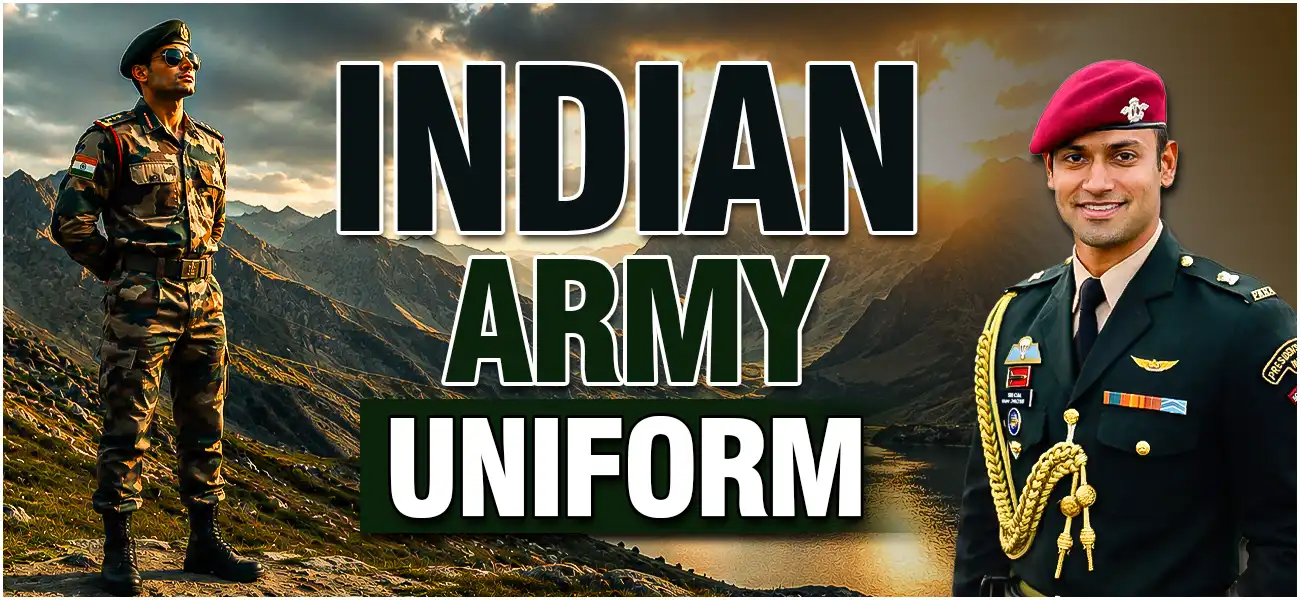
Indian Army Uniform: A Complete Guide for Every Future Soldier and Officer
The Indian Army uniform is far more than a piece of clothing. It is a symbol of sacrifice, discipline, and national pride, worn by lakhs of soldiers who guard India’s borders in deserts, glaciers, jungles, and high-altitude mountains. For every child who dreams of joining the Armed Forces, the Indian Army uniform is the first image that comes to mind — sharp, disciplined, and instantly recognisable.
In this blog, brought to you by Indian Defence School, we take a deep dive into the history, types, fabric technology, ranks, and legal protection of the Indian Army uniform — along with why understanding it matters for every aspiring cadet preparing for RIMC and Sainik School.
Why the Indian Army Uniform Matters So Much
A uniform in the armed forces does three jobs at once: it protects the soldier, it conceals him from the enemy, and it instantly communicates rank, regiment, and identity to fellow soldiers. The Indian Army uniform has been engineered over decades to do all three better, while also reflecting India’s evolving military identity. Every stitch, colour, and badge on the Indian Army uniform carries meaning — from the regimental insignia to the rank slides on the shoulder.
A Brief History of the Indian Army Uniform
The story of the Indian Army uniform is one of continuous evolution:
- Colonial-era origins: Early Indian Army uniforms were heavily influenced by British military dress, featuring wool serge fabrics and traditional cuts.
- Post-independence changes: After 1947, the Indian Army gradually infused its uniform with a distinct Indian identity while retaining functional military design.
- 2008 Disruptive Pattern: For over a decade, Indian soldiers wore an organic disruptive camouflage print, which became one of the most recognisable versions of the Indian Army uniform.
- The 2008 pattern, often nicknamed the “palm frond” or “Indian leaf” pattern, was eventually replaced by a completely new design.
This history shows that the Indian Army uniform has never been static — it keeps adapting to combat needs, climate challenges, and evolving technology.
The New Digital Camouflage Indian Army Uniform
One of the biggest transformations in recent years has been the shift to a digital camouflage Indian Army uniform.
- The new digital pattern combat uniform was officially unveiled by the Parachute Regiment during the Army Day Parade on 15 January 2022, after the Army and the National Institute of Fashion Technology (NIFT) worked together on the design.
- Before finalising the design, fifteen different camouflage patterns were tested, and the chosen pattern uses pixelated, horizontal-stripe camouflage to distinguish Army personnel from paramilitary forces.
- The new Indian Army uniform fabric uses roughly a 70:30 cotton-to-polyester blend, making it lighter, more breathable, quick-drying, and better suited to India’s varied climate — from humid plains to extreme high altitudes.
- It is also more tear-resistant than the earlier version and is available in 13 standard sizes, with gender-specific modifications designed for women officers and soldiers.
- This new uniform is not sold in the open market — it is issued strictly through military, ordnance, or canteen channels, keeping it exclusive to serving personnel.
This makes the modern Indian Army uniform not just a matter of tradition, but a product of serious research, testing, and textile engineering.
Different Types of Indian Army Uniforms: Purpose and Design
The Indian Army maintains multiple Indian Army Uniform variants tailored to specific roles, climates, and occasions. Here’s a detailed overview:
1. General Duty (Olive Green) Uniform
This is the most recognisable everyday Indian Army Uniform. It features an olive-green half-sleeve shirt (summer) or full-sleeve shirt with trousers, paired with a beret or peak cap, depending on the regiment. Practical, smart, and symbolic of discipline, it is worn for routine duties, training, and official functions.
2. General Duty Winter Uniform
In colder regions, soldiers layer up with woollen jerseys, Angola shirts, and the new Battle Jacket. This ensures comfort without compromising the sharp appearance that defines the Indian Army Uniform.
3. Ceremonial Uniform (No. 2 Dress)
Worn during Republic Day parades, state functions, and honours, this includes an olive-green tunic, trousers, medals on the left chest, regimental insignia, and polished accessories. Armoured Corps variants feature distinctive cavalry-inspired elements like rich colours and elaborate headgear, evoking historical mounted traditions.
4. Combat / Jungle Dress
The field-ready Indian Army Uniform for operations. Camouflage patterns (evolving to digital designs) help blend into diverse terrains—from jungles to deserts and high altitudes. It includes full-sleeve shirts, trousers, boots, and accessories like webbing for carrying gear. Special variants exist for Leh-Ladakh’s snowy conditions.
5. Mess Dress and Other Formal Variants
For dinners and formal events, officers wear sophisticated variants with subtle braids, shoulder insignia, and regimental ties. Recent updates allow traditional Indian attire options for officers and introduce Bandi jackets.
Additional specialised uniforms include those for extreme weather, aviation, technical roles, and more—totalling over a dozen variants adapted to India’s vast geography.
Symbolism in the Indian Army Uniform: Insignia, Badges, and Ranks
Every element of the Indian Army Uniform carries deep meaning:
- Rank Insignia: Officers use stars, the national emblem (Lion Capital of Ashoka), crossed swords, and batons. Junior ranks feature chevrons. These signify command, experience, and responsibility.
- Regimental Badges and Colors: Different regiments (like Sikh, Gorkha, or Armoured) maintain unique lanyards, beret colors, and shoulder titles that celebrate their heritage and valor.
- Medals and Awards: Displayed proudly on ceremonial dress, they represent gallantry and service.
- Headgear: Berets, turbans (for Sikh personnel), and peak caps reinforce identity and tradition.
This attention to detail fosters unit pride and instant recognition on the battlefield or parade ground.
Legal Protection: Why You Cannot Buy the Real Indian Army Uniform
A little-known fact is that the modern Indian Army uniform is now legally protected intellectual property.
- The camouflage pattern and design of the new combat uniform have been officially registered with the Controller General of Patents, Designs and Trademarks, Kolkata, giving the Indian Army exclusive ownership.
- This copyright is held by the Indian Army for ten years, extendable by another five, specifically to stop unauthorised vendors from manufacturing or selling the pattern, since counterfeit uniforms pose a genuine security risk to the nation.
- This protection was further strengthened when the Army’s new three-layered Coat Combat — with a digitally printed camouflage outer layer, an insulated inner jacket, and a thermal base layer for moisture control — also received formal design registration.
This is why the real Indian Army uniform is available only through authorised defence channels, and impersonating it or trading it commercially is a punishable offence.
What the Indian Army Uniform Teaches Young Aspirants
For a child preparing for a career in the Armed Forces, the Indian Army uniform represents much more than fabric and camouflage. It stands for:
- Discipline – every crease, badge, and boot is maintained to precision.
- Equality – rank is earned, and the uniform reflects merit, not background.
- National Identity – from Himkavach to the Bandi jacket, the uniform increasingly reflects India’s own culture and self-reliance (Atmanirbhar Bharat).
- Sacrifice – the same uniform is worn in peace and in the harshest battle conditions imaginable.
Understanding these values early helps young aspirants build the mindset needed to wear the Indian Army uniform with honour one day.
Preparing for a Career in the Indian Army: The Role of Specialized Training
At Indian Defence School, recognised as the Best Army Boarding School in India, we believe that respect for the Indian Army uniform begins long before a cadet earns the right to wear one. Our residential coaching programme is specially designed for two of India’s most prestigious entry gateways into the Armed Forces:
- RIMC (Rashtriya Indian Military College) Coaching – structured academic training, physical fitness modules, and psychological preparation aligned with the RIMC entrance exam and interview pattern.
- Sainik School Coaching – comprehensive preparation covering academics, general knowledge, physical fitness, and personality development required to crack the Sainik School entrance exam.
With experienced faculty, a disciplined boarding-school environment, and a curriculum built around the same values the Indian Army uniform represents — discipline, courage, and service — Indian Defence School shapes young minds into confident future leaders of the Indian Armed Forces.
If your child dreams of one day proudly wearing the Indian Army uniform, Indian Defence School is where that journey begins.